

Advanced PBX Data Logger: SMDR and CDR Call Logging Software
For Windows 7 - Windows 11 (incl. Server, x86 and x64)Windows 11, 10, 8.1, 8, 7, Vista, XP, 2000
Windows Server 2025, 2022, 2019, 2016, 2012 R2, 2012, 2008 R2, 2008, 2003
x86, x64. Latest version: 4.1.9 build 1026. October 29, 2026.
- Windows 7 to 11 and Server 2012 to 2025, 32 and 64-bit
- SMDR and CDR call records from hundreds of PBX models
- Free trial of the full program
- About 40 MB download
- Perpetual licence per computer, three editions, free PBX Reports
What it does
Every business telephone system, a PBX (Private Branch Exchange), produces a call record after each call: who called whom, when, for how long, on which trunk and extension. Vendors call these records SMDR (Station Message Detail Recording), CDR (Call Detail Record) or CIL (Call Information Logging), and the PBX sends them out through a serial port, a TCP or UDP port, or writes them to a file. Advanced PBX Data Logger receives these records from one or several PBX systems, splits each record into fields with a parser made for your PBX model, and writes the fields to an SQL database, Excel, CSV files or a web service, in real time. The free PBX Reports program that comes with it turns the records into call accounting reports.
What you can do with it
Keep a complete, searchable history of all calls made and received through your PBX, in a database you own. Bill hotel guests, departments or clients for calls, and send the records to a hotel PMS or a call accounting system. Watch trunk and extension usage, answer times and missed calls with the reports in PBX Reports, on your PC or in a browser. Replace the serial printer that an older PBX still prints its call records to, and stop losing records when the paper runs out. Convert the records of a modern IP PBX to the serial format that an old billing or front-desk system expects. Collect call records from several branch PBX systems into one database for the whole company.
Parsing, export to databases and files, and PBX Reports need the Professional or Enterprise edition. The Standard edition records raw call data to log files. The feature matrix lists every difference.Getting started
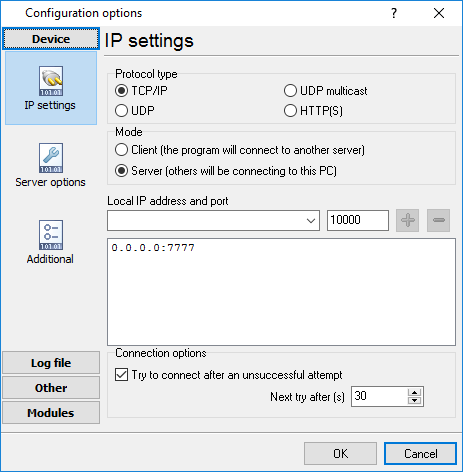
- Install the program and click the green plus button to add a configuration. Choose how the PBX delivers its records: a COM port, a TCP or UDP port in client or server mode, a TAPI driver, or a folder with log files, and enter the settings from your PBX documentation. The default SMDR ports and logins table has the usual values.
- On the Modules page, select the parser for your PBX model from the list of 297 models. Make a test call and check in the main window that the record is split into fields.
- On the Data export page, choose where the records go: a database table, an Excel file, a CSV file or an HTTP API. Switch on the Windows service mode in Program options, so logging continues after you log off. The video how to install PBX Data Logger and the features overview show a first configuration.
Features
Several PBX systems at once. The Enterprise edition collects records from several PBX systems or sites at the same time, each with its own interface, settings and parser. Professional and Standard log one PBX.
297 PBX models supported. Ready parsers for 357 record formats of 297 models from 87 vendors, from legacy Panasonic, NEC, Siemens and Avaya systems to 3CX, Asterisk, Cisco and SIP gateways. See the supported PBX systems.
Any interface the PBX offers. RS232 and RS485 serial ports, TCP in client or server mode, UDP, a TAPI driver, local or remote log files (FTP, SFTP, FTPS), and a RADIUS accounting receiver for session border controllers.
Custom formats. If a record format is not in the list, the parser can be configured for any text call record by fixed positions, delimiters or regular expressions. Or send us a sample and we add the format.
Raw data logging. Writes everything received, unchanged, to log files with a date and time stamp, rotation by date, time or size, deletion of old files and access control, so no record is ever lost.
Databases. Writes records to any ODBC database, to SQL Server, MySQL, PostgreSQL and Oracle through SQL Database Professional, and to cloud databases such as Microsoft Azure, MariaDB, MongoDB and Amazon Aurora.
Excel and files. Writes fields directly into an open Excel sheet, or into Excel, CSV, XML, HTML, RTF, PDF and text files, or into Google Sheets.
Web services and other systems. Sends records by HTTP POST or GET to your API, to an MQTT broker, over SFTP or FTP, by email, or as an OPC UA server or DDE server.
Real time. Each record is parsed and exported the moment the PBX sends it, so reports and billing are current.
Free PBX Reports. The Professional and Enterprise editions include PBX Reports, a call accounting program with predefined traffic, detail, summary and call center reports, filters by site, department, extension or trunk, charts, PDF and Word export, scheduled reports by email and a built-in web server.
Call costs. PBX Reports calculates the cost of each call from your rate tables for the billing reports.
Alarms and notifications. Sends an email, a Telegram or Slack message or an SMS when a record matches a condition, for example an emergency number or a long international call. See events and notifications.
Recovery. Reconnects to the PBX after a network or cable failure, reopens the port at a set time, and can load records from the raw log files into the database later with the import logs plugin.
Filters and conversion. Expressions, Deadband and Aggregator filters calculate, drop or combine fields, and data redirecting passes converted records on to another system (Enterprise edition).
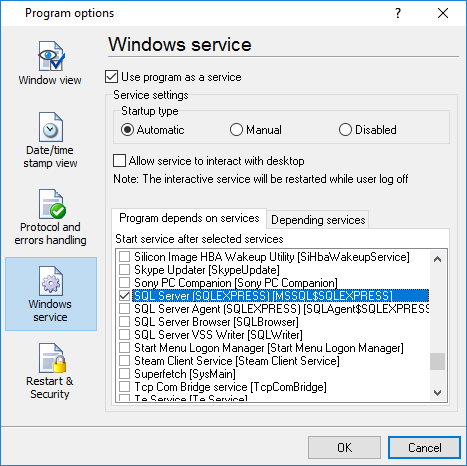
Windows service. Starts with Windows, needs no logged-in user, can wait for services it depends on, such as SQL Server, and keeps running while users log on and off.
Program message log. Records its own messages, warnings and errors to a file, so a connection or database problem can be found later, also when it runs as a service.
How it works: receive, parse, export
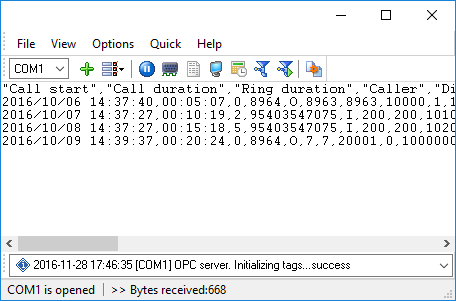
Every configuration is a small pipeline. A data source receives the raw records from the PBX: a COM port, a TCP or UDP connection, a TAPI line or a file. A parser for your PBX model cuts the stream into call records and each record into named fields: date and time, extension, trunk, dialled or calling number, duration, ring time, account code, call cost. Optional filters calculate or change fields and drop records you do not need. One or more export modules write the fields to their targets, and event modules react to them, for example with an email when a condition is met.
The raw stream can be written to a log file at the same time, before any parsing. This is the first part of a fail-tolerant setup: whatever happens to the database or the network later, the records can be restored from these files. How to configure logging to a file before parsing explains the setup, and SMDR to SQL describes the complete chain.
Each stage is a plugin with its own settings dialog, so a configuration is built by choosing options and filling in forms, not by programming. The plugins page lists every module with its manual.
Connecting a PBX
PBX systems deliver call records in a few standard ways, and the logger has a data source for each:
- Serial port (RS232, RS485). Older systems print each record to a serial printer port. The logger opens the COM port instead of the printer, including USB-to-serial adapters. A spy mode can record the traffic when another program already uses the port.
- TCP, the logger connects to the PBX. Many systems open a TCP port and stream records to whoever connects, often after a login. The default SMDR ports and logins page lists the usual port numbers and credentials.
- TCP or UDP, the PBX connects to the logger. The logger acts as a server and waits for the PBX; allowed IP addresses can be restricted.
- TAPI. For systems with a TAPI driver, for example Panasonic KX-TDA, TDE, NCP and NS systems over USB, the logger reads call events from the driver.
- Files. When the PBX or a gateway writes CDR files, the logger watches a local folder or an FTP, SFTP or FTPS server and reads new records as they appear.
- RADIUS accounting. Session border controllers such as Ribbon and Sonus send CDR data as RADIUS accounting packets; the logger receives them directly. See RADIUS, TAPI and CSV call record sources.
If the connection drops, the logger keeps trying to reconnect at a set interval, so a restarted PBX or a replaced cable does not need any attention.
Supported PBX systems and formats
The parser list covers 357 record formats of 297 models from 87 vendors. The supported PBX systems library has a setup page for each popular system with the SMDR settings, the connection mode and port, the parser to select and the fields it extracts, for example Panasonic KX-TDA, Avaya Communication Manager, Cisco, 3CX or Asterisk. Vendor guides list every supported model of Panasonic, NEC, Siemens and Unify, Avaya, Samsung, Mitel and Alcatel-Lucent on one page.
Not sure what your PBX sends? Paste a few lines into the free SMDR and CDR viewer: it detects the format and shows the fields. If your system is not in the list, contact us with a sample of the records; the parser can be adapted to any text call record, and new formats are added regularly.
Hotel systems are covered too: FIAS over TCP (Micros Fidelio), HOBIC and other PMS interfaces.
Where the call records go
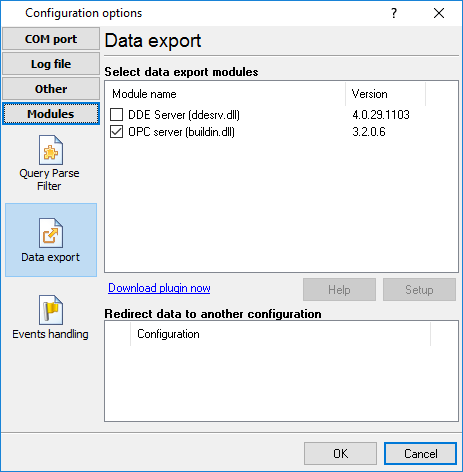
- A database. The usual choice for call accounting and for PBX Reports: SQL Server, MySQL, PostgreSQL and Oracle directly, or any database with an ODBC driver. See SMDR to SQL, configure ODBC database logging, SQL Database Pro and log additional data from your PBX. If the database is offline for maintenance, records wait and are written when it is back.
- Excel and files. Fields go into the rows and columns of an Excel sheet, or into Excel, CSV, XML, HTML, PDF or text files, one per day or month if you like. See the video exporting data to Excel.
- Your own system. HTTP POST or GET requests to a web API, MQTT, email, FTP or SFTP, an OPC UA or DDE server, or keystrokes typed into any Windows program.
- Another PBX interface. With the format conversion and data redirecting plugins the logger works as middleware: it receives records from a modern IP PBX over the network and sends them to a hotel PMS or billing system as serial data in the format that system expects. See Advanced PBX Data Logger as middleware and connecting an IP PBX to CheckInn and PhoneMon.
One configuration can export to several targets at once, for example a database for accounting and a daily CSV file for the archive.
Call accounting and reports with PBX Reports
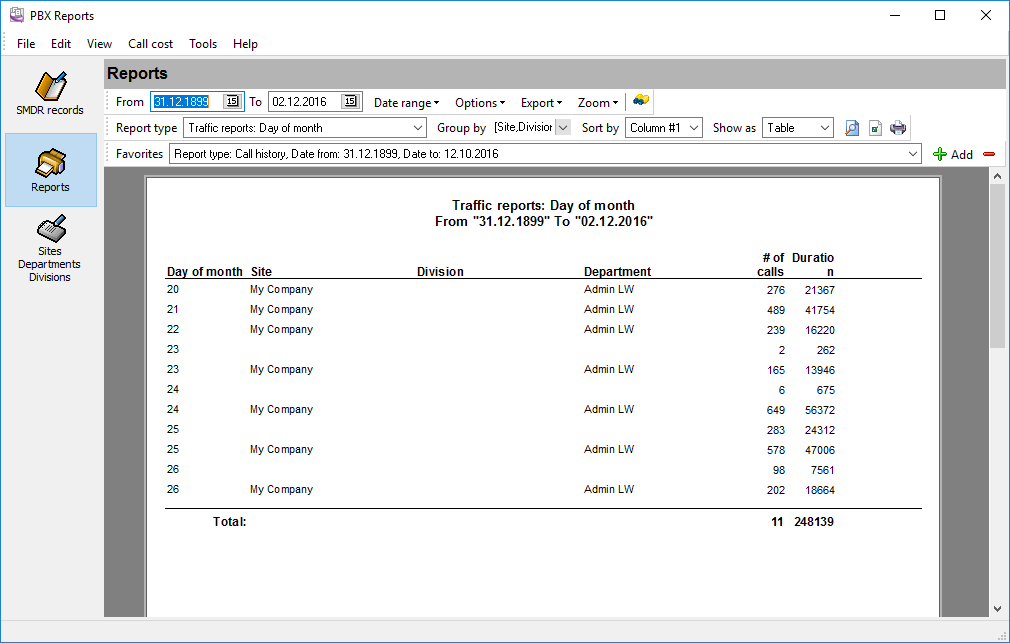
PBX Reports is installed with the logger and is free for Professional and Enterprise customers. It reads the records the logger wrote to the database and produces call accounting reports: traffic by hour, day or month, detailed call lists, summaries by extension, trunk, department, division or site, call center reports with answer times and missed calls, and billing reports with call costs calculated from your rate tables. Reports can be filtered, saved as favourites, printed, exported to PDF or Word, shown as charts, and sent by email on a schedule. A built-in web server lets managers open the reports in a browser from another computer.
PBX call reports describes the report types, the video review SMDR data and build call reports shows the program, and how to view data in PBX Reports covers the database connection. If you already have a call accounting suite, the logger simply feeds it: see call accounting.
Unattended logging as a Windows service
Compared with other tools
Call accounting suites bundle collection, storage and reporting, and usually charge per extension or per PBX. Advanced PBX Data Logger does the collection and storage part for any PBX and gives you the data in your own database, with PBX Reports for the reporting; it can also feed an existing suite that cannot talk to your new PBX. The call logging and SMDR listener and receiver pages describe the role in more detail.
Within the AGG family, Advanced Serial Data Logger and Advanced TCP/IP Data Logger are generic loggers for any serial or network device. The PBX logger shares their plugins and export modules but adds the library of PBX parsers, the TAPI, RADIUS and file sources, and PBX Reports. To look at a port interactively before you set up logging, use Advanced Serial Port Monitor. The data logger software page compares the whole family.
Editions, price and licence
The program is the same for all editions; the licence key sets the edition, and you can upgrade later by paying the difference.
- Enterprise: several PBX systems at the same time (the number depends on the licence), unlimited extensions, all parsers and plugins including the Expressions, Deadband and Aggregator filters and data query modules, PBX Reports.
- Professional: one PBX, up to 48 extensions, all parsers, export and event plugins, PBX Reports.
- Standard: one PBX, raw call data logged to files, no parsing, export or reports.
Plugins with "Professional" in the name, such as SQL Database Professional, Cloud Database Professional and Google Sheets Professional, are paid options. The feature matrix has the complete list.
Prices depend on the edition and on your country. The order page shows the current price of each edition in your currency and the payment options. The free trial is the full program with trial limits; a licence key turns the same installation into the edition you bought, so there is nothing to reinstall.
System requirements
- Windows 11, Windows 10, Windows 8 and Windows 7, and Windows Server 2012, 2016, 2019, 2022 and 2025, 32-bit and 64-bit.
- Older computers: the same program also runs on Windows 2000, XP and Vista and on Windows Server 2003 and 2008; every release is still tested on them.
- For serial connections: a COM port Windows can see, built-in or on a USB-to-serial adapter, and the SMDR cable for your PBX. RS485 systems through a converter.
- For TAPI connections: the TAPI service provider (TSP driver) from the PBX vendor.
- Download size about 40 MB. Database drivers are needed only for the database you export to.
Guides and tutorials
Getting started: how to install (video) · features overview (video) · all tutorials · installing plugins (video)
Your PBX: supported systems and formats · default SMDR ports and logins · SMDR and CDR viewer · VoIP PBX, softswitch and gateway CDR formats
Databases: SMDR to SQL · install with an ODBC database · create an ODBC data source · SQL Database Pro · check the parser · log additional data · exporting to a database (video)
Reports and integration: PBX Reports · PBX call reports · view data in PBX Reports · middleware for integration · IP PBX to CheckInn and PhoneMon
Reference: plugins · feature matrix · screenshots · version history
What's new
[October 26, 2026] AGG Software has released an update for M-Bus, bringing it to version 5.0.1 build 1023. A request set to run once now gets 3 tries in total and then stops. Before, after a timeout, it started again and again.[October 26, 2026] Internet Sharing has been updated. . E-mails with attachments are sent faster.
The version history lists the notable changes; builds with small fixes are not always listed there. The version and release date at the top of this page come from the current installer.
Frequently asked questions
My PBX is not in the list. Can I still use the logger?
Yes. The parser can be configured for any text call record by fixed positions, delimiters or regular expressions, and the raw records can always be logged to a file. Faster: paste a few records into the SMDR and CDR viewer to see whether a known format matches, or send us a sample through the contact page and we add the format.
SMDR or CDR, what is the difference?
None that matters for logging. SMDR (Station Message Detail Recording) is the older term used by Panasonic, NEC, Mitel and others; CDR (Call Detail Record) is common for IP PBX systems, softswitches and gateways; Ericsson calls it CIL. All are one line or block of text per call, and the logger handles them the same way.
Can it calculate call costs?
Yes, in PBX Reports. You enter your rates, and the billing reports show the cost per call, per extension, department or site. Some PBX systems also send a cost field in the record itself; the parser keeps it.
My PBX only has a serial printer port for SMDR. Does that work?
Yes. Connect the port to a COM port or a USB-to-serial adapter on the PC with the cable your PBX manual specifies, set the same baud rate and data bits, and the logger receives what the PBX would have printed. The PBX library gives the settings for each model.
Is PBX Reports free?
Yes, for customers with a Professional or Enterprise licence of Advanced PBX Data Logger. It is included in the installer and reads the records the logger writes to the database.
Can it collect records from several PBX systems or sites?
Yes, with the Enterprise edition. Each PBX gets its own configuration with its own interface and parser, and all records can go to one database. PBX Reports then reports by site, department or PBX.
What happens to the records when the database or the network is down?
Records that cannot be written wait and are written when the database is back. In addition, the raw stream can be logged to files before parsing, and the import plugin can load those files into the database later, so nothing is lost.
Does it keep logging when nobody is logged in?
Yes, in Windows service mode. It starts with Windows, runs without a user session, and can wait for services it depends on, such as SQL Server, before it connects to the PBX.
Is there a free trial, and does it run on Linux?
The download is the full program as a free trial with trial limits; a licence key removes them without reinstalling. It is a Windows program; it runs in a Windows virtual machine if the serial port or network connection is available to the guest.