
Siemens Unify Openscape Office V3 SMDR setup and CDR format
This page shows how to get call records out of the Siemens Unify Openscape Office V3 into Advanced PBX Data Logger: the connection settings, the parser to select and the 14 fields the logger extracts for reports or a database. The settings apply to our logger; other call accounting software may expect a different configuration.
Quick facts
| Item | Siemens Unify Openscape Office V3 |
|---|---|
| Interface | LAN. The PBX sends records to the logger PC; the logger listens on TCP port 7000. |
| Port | 7000 |
| Parser to select | Siemens Unify Openscape Office V3 |
| Fields extracted | 14 |
| Other Siemens systems | Siemens Hicom, HiPath variants and Rolm CDR formats |
Configuring Siemens Unify Openscape Office V3
1. Go to WEB GUI → Basic Settings → Call charges → Output format.
2. Select the necessary format of call records. The compressed output must be enabled.
3. Select the output format "LAN-TCP-Client".
4. Specify the IP address of the computer with our software in the "TCP-Client" field.
5. Save and apply the changes.
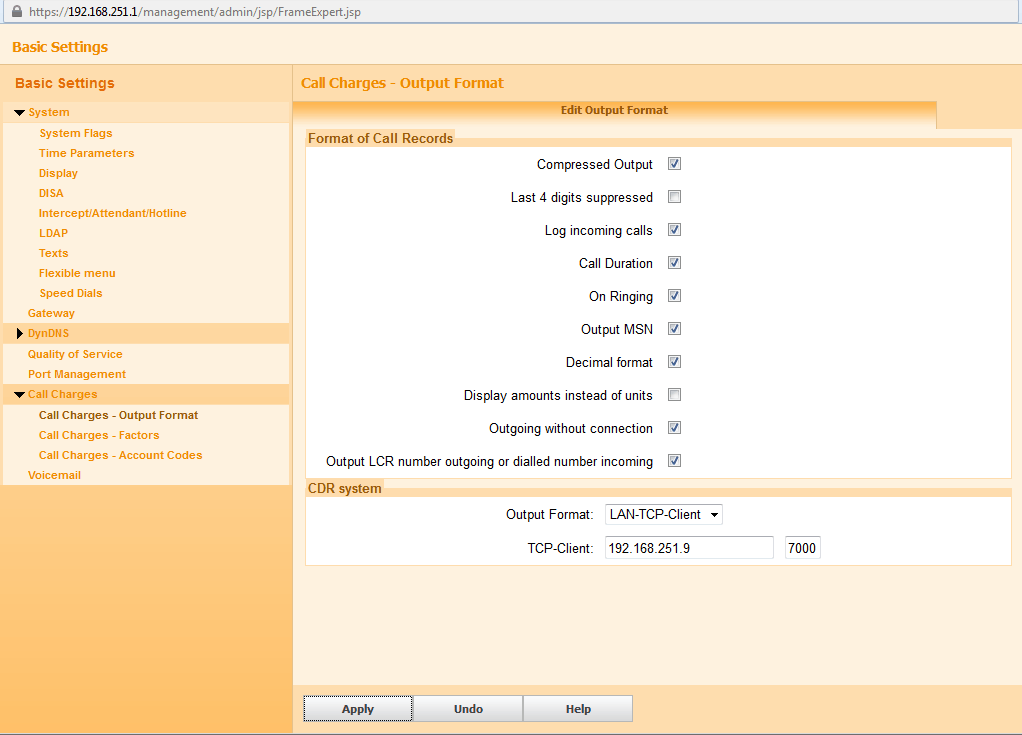
Settings from the manufacturer's documentation
Taken from Siemens Unify Openscape Office V3. Values are those stated in the documentation; confirm them against your firmware release.
| Setting | Documented value |
|---|---|
| CDR transfer protocol and default port (Accounting Manager / Teledata Office V4 download API) | HTTPS (Ethernet LAN with TCP/IP), default port 443 |
| output format supported | Only "Compressed" output format is supported |
| CDR field delimiter and record terminator | Fields delimited by "|"; each record ends with CR LF |
| CDR system supported by this HTTPS format | Only the HTTPS output format is used by Accounting Manager and Teledata Office V4 |
Switching SMDR output on, as documented
- Log on to OpenScape Office Assistant and run the Call Detail Recording wizard: Wizards > Central Telephony > Edit > OK & Next > Finish.
- For information depth and output format, log on with the Expert profile and go to Telephony > Basic Settings > Call Charges > Call Charges, set each parameter, then Apply and OK — matches the page's own "Basic Settings -> Call charges -> Output format" path.
- Before recording call data, perform a GET followed by a DELETE request to define the CDR recording start time.
- When using a Microsoft Windows-based download application, enable TLS V1 and SSL V3 in Internet Explorer settings for the HTTPS download to work.
Record format notes
- Field-by-field layout for the common (non-US) CDR sequence: 1 Date, 2 Time, 3 Trunk number, 4 Internal station number, 5 Ring duration, 6 Call duration, 7 Dialed/received external number, 8 Call charge pulse/amount, 9 Additional info (call type code), 10 PKZ (account/project code), 11 MSN, 12 Access code, 13 LCR route, 14 Dialed/received station number (optional).
- US-specific CDR sequence adds three extra fields after field 13: 14 PRI Nodal Service, 15 PWI WATS-Band, 16 PRI CIC, then 17 Dialed/received station number — a 17-field layout instead of 14.
- Field 9 call-type code table: 1=incoming voice/3.1kHz, 2=outgoing voice/3.1kHz, 3=incoming other services, 4=outgoing other services, 5/6=routed in/out, 7/8=conference legs, 9=outgoing via call forwarding, 0=immediate caller-list output; offsets +20/+30/+40/+50/+70 flag call-setup charges, follow-up records, transit codes, DISA calls, and combinations.
- Field 3 Trunk is the seized trunk number, value range 1-250.
- Field 4 Station: for unanswered calls shows the last station called (hunt group/forward target); for answered calls shows the station that accepted the call; may be preceded by up to a 7-digit node number.
- Field 5 Ring duration format mm:ss; capped/displayed as "59:59" on counter overflow; shown as "00:00" for an incoming call to a busy station.
- Field 6 Call duration format hh:mm:ss; if the call segment never connected, 8 blank characters are output instead; capped at "23:59:59" on overflow.
- Field 7 dialed/received number: if data-protection is enabled, the last four dialed digits are masked as "????"; blank (25 spaces) if no number is available.
- Field 8 charge pulses/amount: converted to a monetary amount using an administrator-set call-charge factor; output occurs whenever charges accrue for the segment, even on transferred calls.
- "Uncompressed" format selection in the admin UI still outputs compressed/pipe-delimited data underneath, but adds a first header line naming the fields, is limited to fields 1-13 (non-US only), and the output cannot be processed by the Accounting Manager tool.
- OpenScape Office does not support continuous/real-time CDR streaming (unlike HiPath 3000); live/online transmission requires using the CSTA interface instead of this HTTPS download API.
Configuring Advanced PBX Data Logger as a TCP server
Advanced PBX Data Logger should be configured to the TCP server mode and listen on 0.0.0.0:7000 (see below). The IP address 0.0.0.0 allows receiving data from all network connections on your computer. The port number should match the value from the SMDR settings in your Siemens Unify Openscape Office.
1. Add a new configuration with the TCP data source (if you didn't it before).
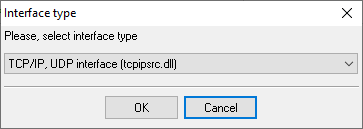
2. Configure the TCP settings as shown below.
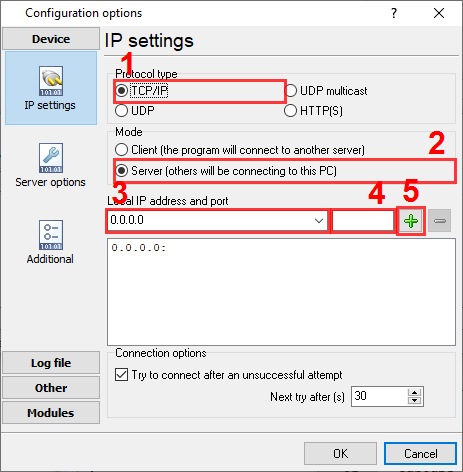
7000
7000
Selecting the correct parser for Siemens Unify Openscape Office V3
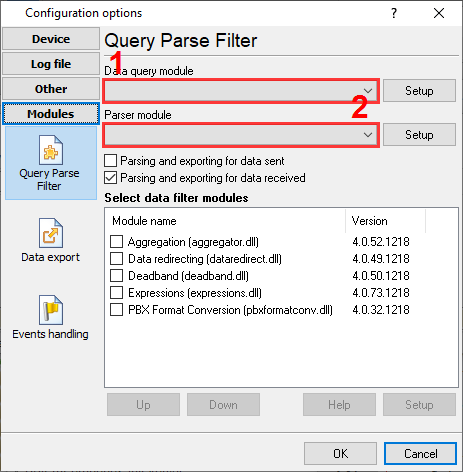
Siemens Unify Openscape Office V3
Siemens Unify Openscape Office V3
Data items
| Description | Data type | Column name |
|---|---|---|
| Call time | datetime | CALL_TIME |
| CO | string | TRUNK |
| Account | string | EXT |
| Ring duration | datetime | RING |
| Call duration | datetime | CALL_DURATION |
| Call duration (s) | integer | CALL_DURATION_S |
| Caller | string | CALLER_PHONE |
| Call type | string | CALL_TYPE |
| Direction | string | DIRECTION |
| Account code | string | ACC |
| Multiple Subscriber Number | string | FLAG1 |
| Access Code | string | FLAG2 |
| LCR-Route | string | FLAG3 |
| Dialed phone | string | DIALED_PHONE |
Sample record
As delivered by the system; phone numbers, names and public addresses are masked.
21.01.15|15:03:47|10|3710|00:05|00:00:17|078xxxxxxxx||1|||||7420|
21.01.15|15:05:13|9|3702|00:03|00:00:00|079xxxxxxxx||2|||9|2|079xxxxxxxx|
21.01.15|15:06:42|9|3718|00:02|00:00:00|288443||2|||9|3|012xxxxxxxx|
Reports and a database
Once records arrive, the logger writes them to a text file or to any ODBC database in real time, or hands them to the PBX Reports utility for manual, scheduled and e-mailed reports with a built-in web server. See exporting call log data to a database for the database setup.
Related Siemens systems
Siemens Unify Openscape 4000Siemens Unify Openscape 4000 (TCP)
Siemens iSDX Realitis
Snom ONE
Siemens Hicom, HiPath variants and Rolm CDR formats
All supported PBX systems
Note: Products and companies mentioned here are used only for definition and identification purposes and can be trademarks and/or registered trademarks of the respective companies.
Related topics: Advanced PBX Data Logger
hereCall logging Call accounting SMDR to SQL SMDR Listener Cables and signals