
Toshiba Strata CIX SMDR setup and CDR format
This page shows how to get call records out of the Toshiba Strata CIX into Advanced PBX Data Logger: the connection settings, the parser to select and the 22 fields the logger extracts for reports or a database. The settings apply to our logger; other call accounting software may expect a different configuration.
Quick facts
| Item | Toshiba Strata CIX |
|---|---|
| Interface | Serial printer port or LAN, whichever the system uses for SMDR output. The record layout identifies the format. |
| Parser to select | Toshiba Strata CIX |
| Fields extracted | 22 |
| Other Toshiba systems | Toshiba Strata DK SMDR formats |
Settings from the manufacturer's documentation
Taken from toshiba-Strata-CIX-Network SMDR R400, toshiba-Strata-CIX-SMDR, Toshiba CTX CIX-SMDROutput. Values are those stated in the documentation; confirm them against your firmware release.
| Setting | Documented value |
|---|---|
| programming tool | eManager |
| SMDR TCP client port (example default used in manual) | 6000 |
| LAN Server Port Number default (Program 801) | 0 |
| LAN Read/Write Retry defaults (Program 801) | 1 |
| output hardware | BSIS PCB provides 4 RS-232 jacks, one dedicated to SMDR and one to SMDI |
| SMDR record buffer size | 1000 records |
| cable/adapter for direct PC (DB9) connection to BSIS | PPTC-9 adapter, crossed RD/TD, DB9 DTE |
Switching SMDR output on, as documented
- In eManager, open Advanced Configuration | System | I/O Device (Program 803) and set Logical Device No. 00 to 100 - SMDR.
- Set Device Connection to LAN, or select a BSIS RS-232 port 1-4 (RS-232 does not support central/network SMDR).
- On the LAN Device tab (Program 801), set Protocol TCP, Application Type Client, Data Flow Asynchronous, and enter the SMDR server's Client IP and Client TCP Port No.
- For RS-232 output, use the RS232 Serial Port tab (Program 804) to set Port Speed, Port Parity, Data Bits and Flow Control to match the SMDR device.
- To enable QoS reporting per call, in Network eManager under System > SMDR enable 'Record QoS Information' on Program 513 (ILG) FK06 and Program 514 (OLG) FK05.
Record format notes
- SMDR record types: B=aBandoned, N=Normal, S=Start, X=transfer, E=End, I=Initial, T=Time change, A=Authorization, C=Charge Account, M=Charge Conference.
- Each call record spans two ASCII lines terminated by CR/LF; the second line begins with '&'.
- Time stamp field is MO/DD HH:MM:SS and call duration is HH:MM:SS.S (tenths of a second); duration means end-of-call for N/E, start-of-call for S, etc.
- From Release 4.0, network/multi-node installs add a 15-character hex Multi-Node Call ID to columns 74-84 of line two, identifying source/destination/single/tandem node plus a per-call hex call number.
- An optional 'Q' (QoS) record reports jitter/delay/packet loss per SIP call, output when the call releases or the SIP session changes (hold/transfer); format includes source/dest IP and RTP port.
Selecting the correct parser for Toshiba Strata CIX
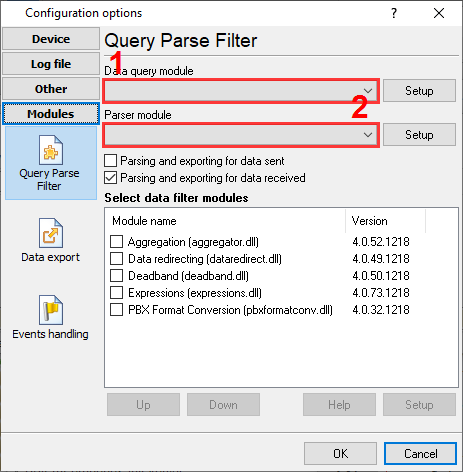
Toshiba Strata CIX
Toshiba Strata CIX
Data items
| Description | Data type | Column name |
|---|---|---|
| Record type | string | CALL_TYPE |
| Record type name | string | RECORD_TYPE_NAME |
| Record ID | string | FLAG1 |
| Node ID | string | FLAG2 |
| Source | string | FLAG3 |
| Destination | string | FLAG4 |
| Trunk | string | TRUNK |
| Extension | string | EXT |
| Call time | datetime | CALL_TIME |
| Call duration | datetime | CALL_DURATION |
| Call duration (s) | integer | CALL_DURATION_S |
| Call direction | string | DIRECTION |
| Phone | string | DIALED_PHONE |
| Phone (w/o city code) | string | DIALED_PHONE2 |
| Caller phone | string | CALLER_PHONE |
| DISA | string | DISA |
| ANI | string | ANI |
| DNIS | string | DNIS |
| AUXID1 | string | AUXID1 |
| AUXID2 | string | AUXID2 |
| Ringing time | datetime | RING |
| VM-CallId | string | CALLID |
Reports and a database
Once records arrive, the logger writes them to a text file or to any ODBC database in real time, or hands them to the PBX Reports utility for manual, scheduled and e-mailed reports with a built-in web server. See exporting call log data to a database for the database setup.
Related Toshiba systems
Toshiba IP EdgeTennyson SOX
Toshiba Strata CTX
Toshiba Strata DK 14,40,424
Toshiba Strata DK SMDR formats
All supported PBX systems
Note: Products and companies mentioned here are used only for definition and identification purposes and can be trademarks and/or registered trademarks of the respective companies.
Related topics: Advanced PBX Data Logger
hereCall logging Call accounting SMDR to SQL SMDR Listener Cables and signals