
Siemens iSDX Realitis SMDR setup and CDR format
This page shows how to get call records out of the Siemens iSDX Realitis into Advanced PBX Data Logger: the connection settings, the parser to select and the 10 fields the logger extracts for reports or a database. The settings apply to our logger; other call accounting software may expect a different configuration.
Quick facts
| Item | Siemens iSDX Realitis |
|---|---|
| Interface | Serial printer port or LAN, whichever the system uses for SMDR output. The record layout identifies the format. |
| Parser to select | Siemens iSDX Realitis |
| Fields extracted | 10 |
| Other Siemens systems | Siemens Hicom, HiPath variants and Rolm CDR formats |
| serial parameters, Full CIL on the V.24 CIL port (fixed, not configurable) (documented) | 1 start bit, 8 data bits, 0 parity bits, 2 stop bits; lowest-order data bit transmitted first |
| recommended minimum baud rate for the CIL/V.24 port, by system size (documented) | Up to 1400 lines: 1200 baud; 1400-2800 lines: 2400 baud; above 2800 lines or ACD systems: 9600 baud |
| PBX IP address source for CIL-over-TCP/IP (documented) | Held in database variable IPACT, set by the maintenance engineer |
ISDX / Realitis by Siemens (Plessey)
Our software cannot translate HEX output from this PBX. So this system should be configured to the "Text" format if you wish to use our Advanced PBX Data Logger.
When this phone system will be is set to the "Text" format then our software will capture outgoing calls.
To change the SMDR output format from HEX to the "Text" format:
LSSP: lists the system parameters.
SPCIT: is the system parameter will need changing.
If it is set to 0 then PBX outputs HEX, if set to 1 it outputs Text.
Settings from the manufacturer's documentation
Taken from Siemens Realitis CIL-spec-issue-5. Values are those stated in the documentation; confirm them against your firmware release.
| Setting | Documented value |
|---|---|
| SPCIT system parameter (CIL output type) | 0 = Full (normal/binary) CIL; 1 = Textual (ASCII) CIL |
| serial parameters, Full CIL on the V.24 CIL port (fixed, not configurable) | 1 start bit, 8 data bits, 0 parity bits, 2 stop bits; lowest-order data bit transmitted first |
| recommended minimum baud rate for the CIL/V.24 port, by system size | Up to 1400 lines: 1200 baud; 1400-2800 lines: 2400 baud; above 2800 lines or ACD systems: 9600 baud |
| CIL TCP server logical port number (Ethernet/LAN access) | 17257 decimal ("Ci" in ASCII) |
| PBX IP address source for CIL-over-TCP/IP | Held in database variable IPACT, set by the maintenance engineer |
Switching SMDR output on, as documented
- System parameters such as SPCIT are changed with the RSSP (revise) MMI command and listed with LSSP (list) — the page only mentions LSSP.
- Only one CIL output type (Full or Textual) can be active on the system at any one time.
Record format notes
- Textual CIL record template: ORIG line, then CALLED line, then TIME/DUR/A:C/METER line.
- ORIG field originator-type codes: EX=extension, OC=operator console, OG=operator group, TK=trunk.
- The <message> slot in the CALLED line is normally blank; only populated with CONFERENCE (more than two parties) or TRANSFER (call transferred).
- A/C (account code) field and its label are both omitted from the output entirely when no account code applies — explains why the page's sample record has no A/C field.
- If a CIL record is generated before the system clock/date has been set, the TIME field digits are replaced with "?" characters.
- Textual CIL records are generated only for outgoing PSTN/inter-PBX trunk calls, at call termination or on transfer — matches the page's claim that Text format "will capture outgoing calls".
- Full CIL is genuinely binary/hex and needs dedicated CIL decoding equipment to interpret — supports the page's "cannot translate HEX output" framing.
- Textual CIL is not recommended on high-call-volume systems because the output has no flow control and records can be lost.
- The Ethernet/TCP CIL server (port 17257) carries only Full (binary, 22-octet) CIL records — Textual/ASCII CIL is documented only over the V.24 serial port, not over the LAN.
- On the serial CIL port the DX switch is the DCE and the connected printer/VDU/logger is the DTE; data must never be sent from the logger back into the DX or it can crash the switch.
Selecting the correct parser for Siemens iSDX Realitis
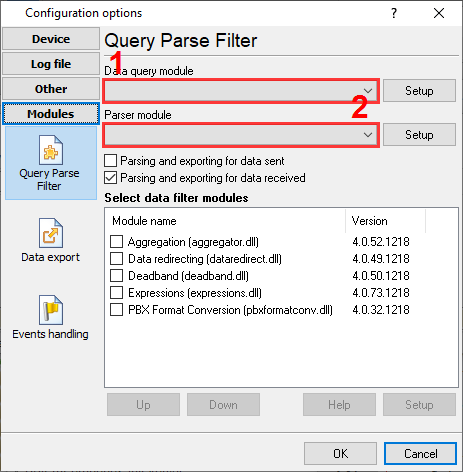
Siemens iSDX Realitis
Siemens iSDX Realitis
Data items
| Description | Data type | Column name |
|---|---|---|
| Call time | datetime | CALL_TIME |
| Call duration | datetime | CALL_DURATION |
| Call duration (s) | integer | CALL_DURATION_S |
| Flag 1 | string | FLAG1 |
| Dialed number | string | DIALED_PHONE |
| Call type | string | CALL_TYPE |
| Access code | string | ACC |
| Call type | string | DIRECTION |
| CO | string | TRUNK |
| Ext | string | EXT |
Sample record
As delivered by the system; phone numbers, names and public addresses are masked.
ORIG: TK1903
CALLED: (705 ) 715234              TK1927       TRANSFER
TIME: 10:15:49  25/02/08  DUR: 00:00:00                 M
Reports and a database
Once records arrive, the logger writes them to a text file or to any ODBC database in real time, or hands them to the PBX Reports utility for manual, scheduled and e-mailed reports with a built-in web server. See exporting call log data to a database for the database setup.
Related Siemens systems
Siemens Unify Openscape Office V3Siemens Unify Openscape 4000
Snom ONE
Sonus 2000 SBC
Siemens Hicom, HiPath variants and Rolm CDR formats
All supported PBX systems
Note: Products and companies mentioned here are used only for definition and identification purposes and can be trademarks and/or registered trademarks of the respective companies.
Related topics: Advanced PBX Data Logger
hereCall logging Call accounting SMDR to SQL SMDR Listener Cables and signals