
Best serial over Ethernet tools by situation: 2026 guide
Serial over Ethernet software carries the data of a COM port through a TCP/IP network. The tools differ less in speed than in what they can connect to: a program that knows only COM ports, a device server that expects RFC 2217, a Linux box, or a script. This guide sorts them by that.
By AGG Software. We make TCP COM Bridge, one of the tools below. The facts about the other products come from their own websites, read on 17 September 2026. "Not stated" means the vendor's page does not say. We did not benchmark the tools.
The tools at a glance
| Tool | Licence | Runs on | Virtual COM port | Windows service | RFC 2217 | Latest release listed |
|---|---|---|---|---|---|---|
| TCP COM Bridge (AGG Software) | Commercial, 21-day trial | Windows | Yes | Yes (Professional edition) | No | 1.8.3 build 515 |
| com0com with hub4com or com2tcp | Free, GPL | Windows | Yes, in pairs | Not stated | Yes (hub4com) | Not stated |
| tcp2com | Free, GPL v2 | Windows | Not stated | Yes | Not stated | 1.0.0; project updated April 2013 |
| HW VSP3 (HW group) | Freeware, single port | Windows | Yes | Yes | Yes | 3.1.2; the vendor marks the product "run-out" |
| VSPE (Eterlogic) | No licence needed on 32-bit Windows, licence required on 64-bit | Windows | Yes | Not stated | Not stated | 1.5.8.489, 4 January 2026 |
| ser2net | Free, GPL 2.0 | Linux; can be built for Windows | No, it serves real ports | - | Yes | Not stated |
| Serial to Ethernet Connector (Electronic Team) | Commercial | See the vendor's site for the current platform list, protocol support and version | ||||
Pick by situation
A Windows program knows only COM ports, the device is somewhere on the network
You need a virtual COM port that leads to an IP address and a port. TCP COM Bridge, HW VSP3, VSPE and Serial to Ethernet Connector all create one. The far end can be a second copy of the same tool on the computer that owns the device, or a hardware device server in raw TCP mode. Setup with TCP COM Bridge: COM port redirector.
The device server insists on RFC 2217
With RFC 2217 the client sets the baud rate and the control lines of the remote port over the network. HW VSP3 and hub4com implement it on Windows, and ser2net on the serving side. TCP COM Bridge does not implement RFC 2217; use it with boxes that offer a raw TCP port, where the baud rate is set in the box itself.
It must be free, and a command line is fine
com0com is an open-source kernel-mode virtual serial port driver; its companions hub4com and com2tcp move the data to TCP. There is no graphical setup, and you maintain the configuration yourself. For one real port that should simply be reachable by telnet, tcp2com runs as a Windows service, but the project has not been updated since 2013: see TCP COM Bridge vs tcp2com. HW VSP3 is freeware for a single port; its vendor lists it as a run-out product.
Many ports on one machine, running unattended
Here a Windows service, a configuration you can copy, and per-connection counters matter more than price. TCP COM Bridge (Professional edition) starts as a service before anyone logs on, works with up to 255 COM ports on one computer, reconnects after a network failure and can buffer serial data while the link is down: serial device server setup.
One end runs Linux
Run ser2net on the Linux machine that owns the serial port and connect to it from Windows with any tool that speaks raw TCP, or RFC 2217 if you need remote baud rate control. TCP COM Bridge works with the raw TCP mode.
No network at all: two programs on one computer
That is a different kind of tool: a pair of linked virtual ports. com0com does it for free. Commercial options are our Virtual Null Modem and Virtual Serial Port Driver by Electronic Team (virtual-serial-port.org). To give several programs the data of one real device, see serial port splitter.
There is no computer near the device
Use a hardware device server (Moxa, Lantronix, Digi and others make them) at the device, and one of the virtual COM port tools above on your computer. More on the choice: software or a hardware device server.
The tools in detail
TCP COM Bridge
Our own tool. It connects physical or virtual COM ports to TCP or UDP as a client or a server, splits and shares ports, and keeps connections alive without supervision.
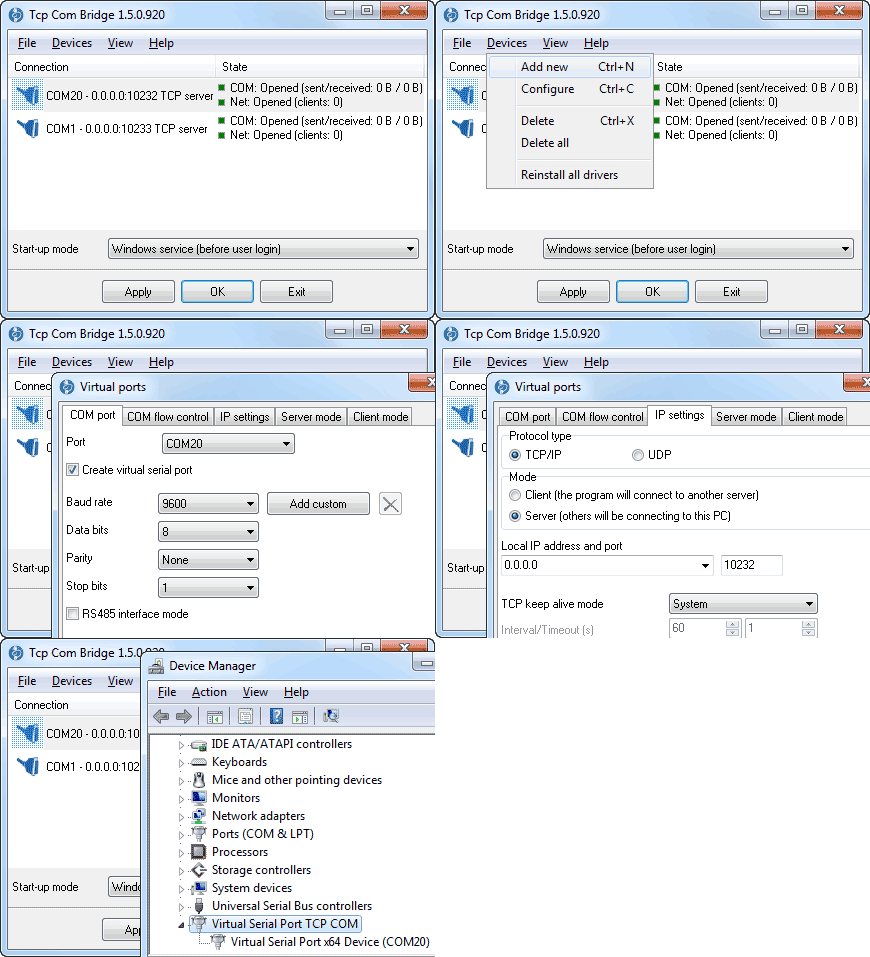
- Up to 255 physical or virtual COM ports on one computer. The Standard edition is limited to two connections; the Professional edition has no connection limit.
- The Professional edition adds the Windows service mode, UDP, keep-alive packets, the command line and traffic encryption (a proprietary algorithm between two copies of the program; for Internet links combine it with a VPN or the list of allowed IP addresses).
- Handles dynamic IP addresses through a domain name.
- Limits: Windows only; raw data stream, no RFC 2217. The trial works for 21 days with three connections, and each work session is limited to 128 KB or 2 hours.
com0com, hub4com, com2tcp
The project describes com0com as "an open source kernel-mode virtual serial port driver for Windows, available freely under GPL license". It creates pairs of virtual COM ports. hub4com lets several applications handle the data of one serial device and makes remote ports usable locally, with RFC 2217 support. com2tcp is a COM port to TCP redirector. Project page: com0com.sourceforge.net.
tcp2com
"tcp2com creates a bridge between a TCP socket and a serial port (COM). The program runs as a service under Windows NT." GPL v2, version 1.0.0, last project update in April 2013. No virtual COM ports are mentioned. Project page: tcp2com.sourceforge.net.
HW VSP3
A virtual serial port driver by HW group that redirects the data of a virtual COM port over TCP/IP to a device at a given IP address and port. It supports RFC 2217 and runs as an application or as a service. The single-port version is freeware; the multi-port version is tied to HW group hardware. The vendor lists version 3.1.2 and marks the product as "run-out". Vendor page: hw-group.com.
VSPE
Virtual Serial Ports Emulator by Eterlogic is a test-bench tool with many device types in one window, among them Pair, Splitter, TcpServer, TcpClient, Serial Redirector and UDP Manager. It needs no licence on 32-bit Windows and a licence on 64-bit Windows. The vendor lists version 1.5.8.489 of 4 January 2026 and support for Windows 10, Windows 11 and current Windows Server versions. Vendor page: eterlogic.com.
ser2net
An open-source program (GPL 2.0) that makes serial ports available over the network, mainly on Linux. It offers raw TCP, telnet with RFC 2217 and encrypted connections. Project page: github.com/cminyard/ser2net.
Serial to Ethernet Connector
A commercial serial over Ethernet product by Electronic Team and the closest commercial alternative to TCP COM Bridge. Check the vendor's site for the current platform list, protocol support and prices: electronic.us.
See what actually travels through the link
When a link is up but the device does not answer, look at the bytes. Advanced Serial Port Monitor opens the real or the virtual COM port and shows the traffic in HEX or ASCII.
See also
Install TCP COM Bridge: setup, driver, first connection
Serial port splitter: one COM port for two or more programs
Serial device server: many COM ports on one Windows PC
Share a COM port over the network
COM port redirector: a virtual COM port to a TCP/IP address
Redirect COM ports to a terminal Windows server
Serial over Ethernet: how it works
Connect two COM ports on the same computer
Printing on one receipt, POS or fiscal printer from two computers
Fix slow receipt printing from remote accounting software
Serial to TCP/IP converter software
Best serial over Ethernet tools by situation
TCP COM Bridge vs tcp2com: when the free tool is enough
TCP COM Bridge troubleshooting
Related topics: TCP COM Bridge
hereSerial over Ethernet | Serial to TCP/IP converter | COM port redirector | Serial port splitter | COM port sharing | Serial device server | Serial port monitor | RS232 pinout and signals | Virtual Null Modem | COM Port Emulation